
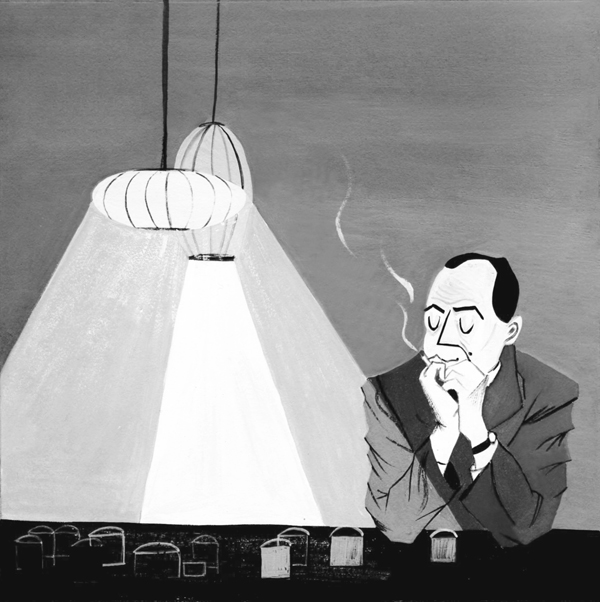
 (George Nelson’s portrait by Josie Portillo)
George Nelson dominated the Mid-Century Modern design and architecture scene since its early years.
Although he is considered to be amongst the most influential designers of the twentieth Century, he never was a ‘traditional’ designer.
Despite this, Nelson and his office invented some of the most iconic furniture and home appliances of the Mid-Century Modern time like the Storagewall, the multimedia presentation, the open plan office system or the Bubble lamp, the Ball clock, the Marshmallow sofa and the Coconut Chair.
He was an eclectic -architect, urban designer, interior designer, graphic designer- more interested in writing about architecture and travel than in the construction business.
Nelson was born in 1908 in an highly educated family. When discussing his own origins, he used to say: “There was none around who said ‘Go out and get rich’, so I followed their instructions and never did”.
It is no surprise then if he became a curious traveller with no concern in making money.
In 1924, Nelson joined Yale University without having a clear idea of what to study, but one day, finding shelter in the university from a sudden storm, he found himself in the faculty of architecture.
There, a student presentation of tempera and watercolor renderings called ‘A Cemetery Gateway’ was taking place.
He was so amazed of what he had just seen that he decided with no hesitation that he would become an architect: “They were the most exquisitely beautiful and exciting things I had ever seen in my life. I fell in love instantly with the whole business of creating designs for cemetery gateways. This was when, without any further question on my part, I decided I had to be an architect.”
After the graduation in 1928 -one year before the economic crash that canceled every construction plan around the country making the architects useless- Nelson started the academic career to get bored of it already one year later.
In 1929 he ran for, and won, the contest ‘Rome Prize’; the prize consisted of two years at the American Academy in Rome with all the expenses covered, the ideal solution to the lack of work during those years.
The following years Nelson traveled throughout Europe writing about architecture and interviewing the leading designers and architects of the time like Le Corbusier, Mies Van de Roe, Walter Gropius and Gio Ponti. The interviews, published in the US between the ‘35 and ‘36, showed his peculiar, admiring and often sarcastic point of view on the European architecture, the Bauhaus revolution and its protagonists.
Those years outlined the first phase of his career as a writer.
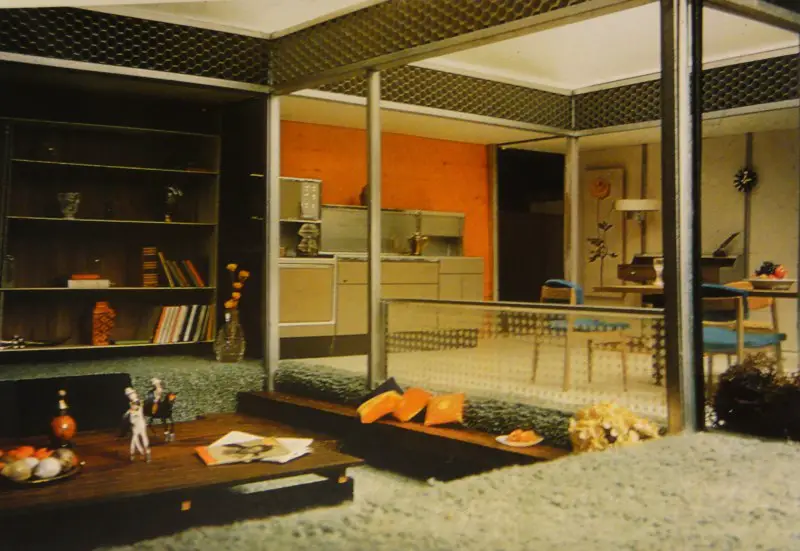
Back to the US, Nelson worked mainly as journalist for architecture magazines like ‘Architectural Forum’.
He was reporting about the new household design, the new needs of the mid-century modern American families and the way the consumerism was changing the house concept itself and the use of the inner spaces.
In 1945, Nelson and his Forum colleague Henry Wright wrote ‘Tomorrow’s house’.
The book was gathered all the authors’ ideas and believes about the middle contemporary architecture language and interior decorating ideas.
‘Tomorrow’s House’ was not an usual book about interiors, its heart was the new rooms’ uses basing on the needs of their inhabitants. The function of the room, specially of the living room, was the biggest concern of the authors that used the modernism as a tool to find the answers to the new needs of the contemporary house owners.
The most revolutionary idea in the book was probably the Storagewall.
When it was the moment to write the chapter on storage, Nelson and his colleague had an hard time:
“I was sitting in my office, staring at the wall, miserable; we had just had another angry call from the publisher. I was looking at the wall and something in my head said, ‘What’s inside, how thick is that wall?’.
I thought, ‘Who cares how thick the wall is, it’s probably 4 or 5 inches, go away.’
And again, the real feeling of a dialogue with an unwanted visitor:
‘What is inside the wall?’
‘Hollow tile with plaster on top of it’
‘What else?’
‘Nothing.’
‘Do you mean there is a vacuum?’
‘Not a vacuum, air’
‘Air’ was the trigger. Suddenly all those unrelated things crashed together and I realized that the essential element in any storage unit of any sort or size was air. A closet has so much air. And I thought, ‘My goodness, if you took those walls and pumped more air into them and they got thicker and thicker until maybe 12 inches thick, you would have hundreds and hundreds of running feet of storage. It didn’t take enough inches off the room on either side to be noticed’ ” (S. Abercrombie – [amazon_link id=”0262511169″ target=”_blank” container=”” container_class=”” ]George Nelson, The Design of Modern Design[/amazon_link])
The Storagewall caused an earthquake in the design world and thanks also to it ‘Tomorrow’ house’ become a best-seller.
The Nelson’s Storagewall was a revolutionary idea that for the first time mixed architecture and furniture: modular and flexible.
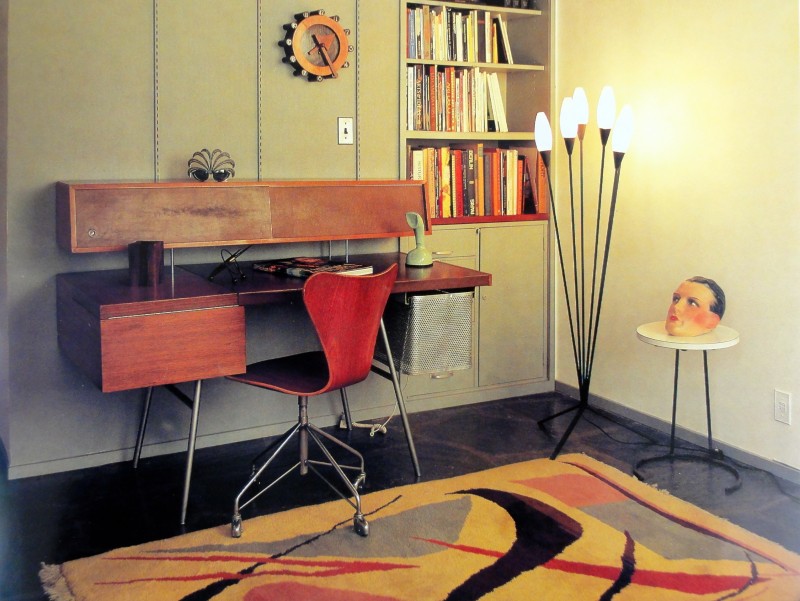
In the same period of the Nelson’s Storagewall revolution the founder of Herman Miller Furniture, D.J. DePree, was looking for a new chief designer after Gilber Rohde suddenly death.
DePree was considering some of the most innovative architect/designers of the time for the position, when he ended up reading an article in Life magazine about the Nelson’s Storagewall and decided to contact him for the job.
The negotiation was long, Nelson wasn’t really interested in a design career and quite critic about it, but in the end he accepted and this spurred him to open his own office as well: the George Nelson & Associates.
Since the first moment of his 25 years long collaboration with D.J. DePree, Nelson asked to talented and revolutionary artists to join him at Herman Miller.
Some of them were Isamu Noguchi and Charles Eames. He spotted Eames already in 1940 during the MOMA’s “Organic Design in Home Furnishings” competition where Eames and Eero Saarinen stood out in the woodwork section with their ‘Conversation, Relaxation and Lounging‘ trio.
The first collection designed by Nelson for Herman Miller in 1947 was an huge success.
Interiors announced: “Available now the best furniture in years”.
Through 25 years George Nelson designed for Herman Miller some of the milestones of the Mid-Century Modern furniture like the Marshmallow sofa, the Slat Bench, the precursor of the contemporary L-shaped office desk, the CSS (Comprehensive Storage System), the Swaged-Leg Chair and the Sling Sofa.
All the products designed by Nelson were based on the idea that “total design is nothing more or less than a process of relating everything to everything.”
That’s why all of his products were centered on the human beings, their needs’ understanding and to find the right mix of function/design to fulfill them.
He did so and that is why he became one of the most revolutionary artists of the Mid-Century Modern age.
If you want to see more pics about the George Nelson’s works, check the original series George Nelson: The Origin of a Doozy Success Part 1 – Part 2 – Part 3
If you found this Bio interesting, don’t forget that you could discover much more about mid-century joining the completely free and spam-proof Mid Century Home mailing list, now!
You will receive only a weekly email with exclusive content that I don’t publish on the blog.
Thanks for reading and ciao.
